In our daily life, when we are shopping for leather goods like leather backpack for men and women, leather handbags, leather jacket, usually we are confused that whether they are genuine leather or synthetic leather materials and are concerned that maybe we will be cheated and make a wrong purchasing decisions. Today I will show you various methods to distinguish these different leather materials and make you an expert in making choices.
How to Distinguish Genuine Leather
The main ways to distinguish genuine leather are observing the texture, feeling the touch, smelling the odor, conducting a water absorption test, and performing a combustion test, among which the first four methods are more commonly used and safe.
Texture Observation Method
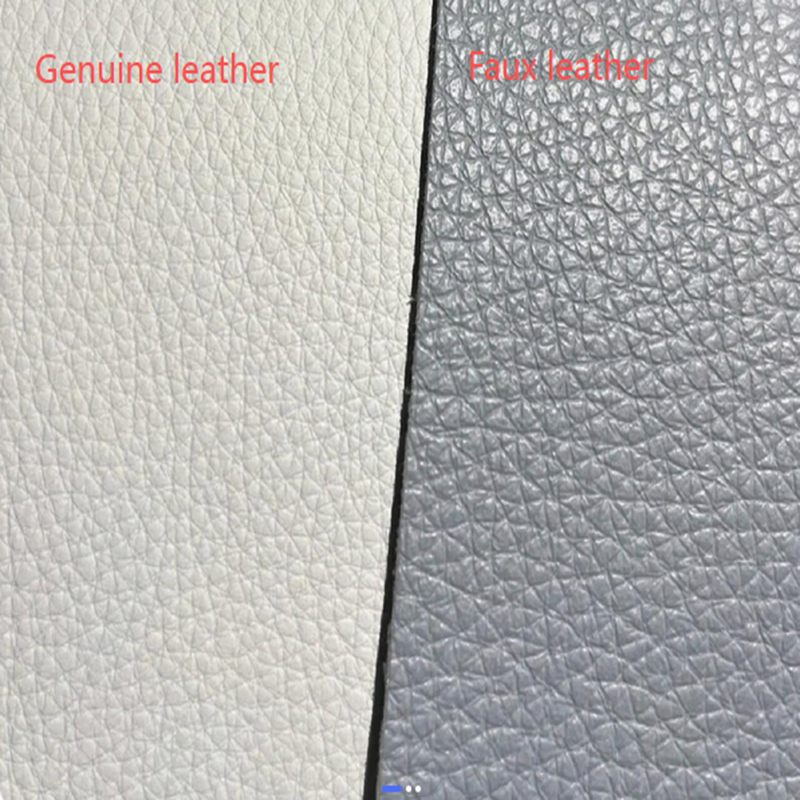
– Texture Characteristics: Genuine leather has natural and irregular textures, with unevenly distributed pores, and the grains vary in different parts.
– Glossiness: Genuine leather has a natural and soft luster, while synthetic leather is too uniform and rigid.
– Cross-Section Structure: The cross-section of genuine leather shows a fibrous layered structure with fine fibers inside.
-Back texture: Genuine leather’s back shows messy natural fibers, while synthetic leather back are smooth fabric bases.
Touch Feeling Method
– Softness: Genuine leather feels soft and delicate, with elasticity and a warm texture.
– Resilience: When pressed with fingers, genuine leather will leave a temporary indentation and recover quickly.
– Concavity and Convexity: A slight natural texture can be felt when touching.
-Winter warmth: Genuine leather feels warm when touching in cold weather, while synthetic leather feels cold when touching in cold weather.
Odor Judgment Method
– Odor of Genuine Leather: It has a unique natural leather smell, similar to the scent of animal fat, which is not pungent.
– Odor of synthetic Leather: It has a strong plastic or chemical solvent smell.
Water Absorption Test Method
– Performance of Genuine Leather: It has good water absorption; water droplets will be slowly absorbed and leave water stains.
– Performance of synthetic Leather: The surface has a plastic coating, so water droplets float and are not absorbed.
Combustion Test Method (Use with Caution)
– Combustion of Genuine Leather: It emits a smell similar to burning hair, and the ash after combustion is powdery.
– Combustion of synthetic leather: It produces a pungent plastic smell, and forms molten lumps after combustion.
Auxiliary Judgment Methods
– Price Factor: The cost of genuine leather products is relatively high, so the price is more expensive.
– Brand Certification: Regular brands usually mark “top-grain cowhide” and other labels, and provide quality certification.
How to Distinguish Microfiber Leather
The core of distinguishing microfiber leather (also known as microfiber synthetic leather) lies in comparing its texture, touch, resilience, and testing its water absorption and wear resistance, which can effectively distinguish it from genuine leather and ordinary artificial leather.
Texture Observation
– Surface Texture: Microfiber leather has a uniform and regular texture, with simulated pores arranged neatly (no natural randomness like genuine leather); the surface is smooth without obvious flaws, and the color is even.
– Cross-Section Structure: Cut a small corner (if allowed), the cross-section of microfiber leather shows a dense fibrous structure (similar to genuine leather but more regular), while ordinary artificial leather has a distinct “film + base cloth” layered feeling.
- Touch and Resilience Test
– Touch Feeling: It feels soft and plump, with a texture close to top-grain leather, but lacks the natural warmth of genuine leather; it is not as stiff as PVC leather.
– Resilience: Press firmly with your finger and release it. Microfiber leather will quickly rebound without leaving a permanent indentation (its resilience is even better than some low-grade genuine leather).
- Water Absorption and Permeability Test
– Water Absorption: Drop a small amount of water on the surface. Microfiber leather will absorb it slowly (weaker than genuine leather but much better than ordinary artificial synthetic leather with a plastic coating).
– Permeability: After absorbing water, touch the back of the material; it will have a slight damp feeling, while ordinary artificial leather is completely impermeable (the back remains dry).
- Wear Resistance and Friction Test
– Use a dry cloth to rub the surface vigorously 20-30 times. Microfiber leather will not fade or peel off; ordinary artificial leather may have obvious fading or film damage.
– Scratch the surface with a nail (lightly). Microfiber leather has strong scratch resistance, and the scratch can be flattened by rubbing with fingers; genuine leather will leave a permanent scratch.
- Odor and Combustion (Use with Caution)
– Odor: It has a faint chemical smell (weaker than ordinary artificial synthetic leather) and no natural leather smell.
– Combustion (For Professional Identification Only): It emits a mild plastic smell when burning, and the ash is granular (not powdery like genuine leather, nor molten lumps like PVC leather).

How to Distinguish PU Leather from PVC Leather
The key to distinguishing PU (Polyurethane) leather from PVC (Polyvinyl Chloride) leather lies in touch feeling, flexibility, burning test, and environmental adaptability, with simple and non-destructive methods (touch, flexibility) being preferred for daily identification.
- Touch and Texture Observation
– PU Leather: It feels soft and delicate, with a texture close to genuine leather; the surface has natural simulated pores, and the gloss is mild (not dazzling).
– PVC Leather: It feels stiff and plastic-like, with a smooth or slightly sticky surface; the gloss is relatively bright, and the simulated pores are stiff and regular (lacking natural sense).
- Flexibility Test
– PU Leather: It has good flexibility; folding it repeatedly (10-15 times) will not produce obvious creases, and it can quickly recover its shape without cracking.
– PVC Leather: It has poor flexibility; folding it 3-5 times will leave obvious and difficult-to-recover creases, and even small cracks may appear at the folded part (especially in low-temperature environments).
- Burning Test (Use with Caution, for Confirmation Only)
– PU Leather: When burned, it emits a faint smell of polyurethane (similar to burning plastic but not pungent); the burning speed is slow, and the ash is brittle and easy to crush.
– PVC Leather: When burned, it produces a strong pungent smell of hydrogen chloride (acrid smell), accompanied by black smoke; the burning part will melt and drip, and the residue is hard and lumpy.
- Environmental Adaptability (Auxiliary Method)
– PU Leather: It has good low-temperature resistance; it will not become stiff or brittle even in an environment of -10℃ to 0℃.
– PVC Leather: It is sensitive to low temperature; when the temperature is below 0℃, it will become extremely stiff, and it is easy to crack when bent slightly.
- Weight Comparison
– PU Leather: The density is lower, so it is lighter in weight (suitable for light products such as bags and clothing).
– PVC Leather: The density is higher, so it is heavier; holding it in the hand has an obvious “plastic weight sense”.

How to distinguish between Vegan leather from PU leather
Distinguishing between Vegan leather and PU leather requires a comprehensive judgment based on multiple dimensions, because PU leather is actually a subset of Vegan leather, but there are obvious differences in material quality and performance between the two.
Identification of Material Composition
– Vegan leather: Covers a variety of materials, including Microfiber vegan leather and plant-based leather (such as pineapple leaf fiber, mushroom mycelium, etc.).
– PU leather: Specifically refers to Polyurethane leather, which is composed of a fabric base and a PU coating.
Observation of Appearance and Texture
– Surface Characteristics
– Vegan leather: The texture is naturally uniform, delicate and deep; high-end products are almost indistinguishable from genuine leather.
– PU leather: The texture is too uniform and repetitive, often with a plastic feel or excessive luster.
– Edge Treatment
– Vegan leather: The edges are smooth and neat, with an obvious plastic texture.
– PU leather: The edges may be rough, and delamination can be seen at the junction of the coating and the base fabric.
Touch Test
– Touch Difference
– Vegan leather: Soft and elastic, with a touch close to genuine leather; high-grade Microfiber versions have a luxurious feel.
– PU leather: Either too hard or overly soft, with a strong plastic feel and lack of the warmth of genuine leather.
– Elasticity Test
– Vegan leather: Rebounds quickly after being pressed without leaving marks easily.
– PU leather: Rebounds slowly and is prone to leaving indentations.
Odor Identification
– Odor Characteristics
– Vegan leather: Neutral or mild odor; high-end products have almost no peculiar smell.
– PU leather: Usually has an obvious chemical odor, similar to plastic or glue.
Water Drop Test
– Water Absorption
– Vegan leather: Generally does not absorb water; water drops form beads and roll off the surface.
– PU leather: Also waterproof, but cheap PU may experience coating peeling after long-term contact with water.
Price Reference
– Price Range
– Vegan leather: High-quality products are relatively expensive, usually 2-3 times more expensive than low-grade PU.
– PU leather: Cost-effective, with prices ranging from tens to hundreds of yuan.
Label Identification
– Product Labeling
– Check if it is clearly marked with words such as “Microfiber vegan leather” or “Plant-based leather”.
– PU leather is usually labeled as “PU leather”, “Synthetic leather” or “Bonded leather”.